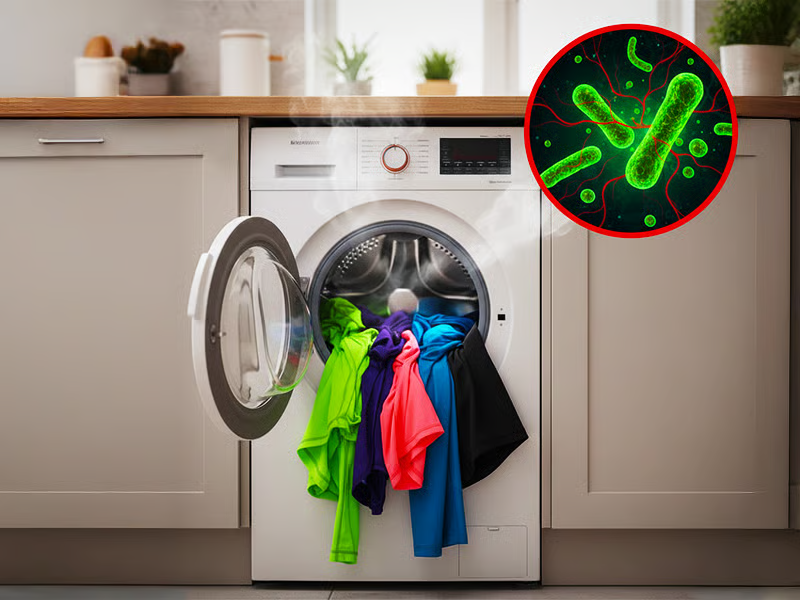
Few laundry problems are more frustrating than putting on a freshly washed top, only to notice the old smell returning halfway through a workout.
The wash may have removed visible dirt and reduced the immediate odour without removing enough body oils, bacteria and odour compounds from the fabric.
Polyester is particularly prone to retaining oil-based residue. When the garment becomes warm and damp again, compounds left behind can become easier to detect, while fresh perspiration may contribute to further odour development.
Often known as ‘Boomerang Smells’.
What Actually Causes Gym Clothes to Smell?
Sweat gets most of the blame, but the smell in well-used gym kit comes from a more complex mixture.
On its own, sweat does not cause the sour musty odour that can become established in activewear.
Clothing also collects sebum, dead skin cells, deodorant, skincare products and other organic residue. Skin bacteria can transform components of these secretions into volatile fatty acids, sulphur-containing molecules and other compounds detected as body odour.
What reaches the garment |
Why it matters |
|
Perspiration |
Adds moisture, salts and odour precursors |
|
Sebum and body oils |
Leave oily residue that adheres readily to synthetic fibres |
|
Skin cells and product residue |
Add organic material that can accumulate through repeated wear |
|
Bacteria |
Transform components of body secretions into odorous compounds |
|
Volatile odour compounds |
Produce the smell noticed during storage or wear |
Some odorous compounds form on the skin before transferring to clothing. Others may develop while a damp kit sits in a bag or laundry basket.
Once body oils and odour-producing material remain associated with the fabric, removing visible dirt is not always enough.
Why Does Polyester Hold Onto Odour More Than Cotton?
Polyester absorbs very little water and dries quickly. The fibre itself is hydrophobic, meaning it has relatively little natural affinity for water.
By contrast, polyester has a stronger affinity for oily substances such as sebum, fatty acids and some deodorant residues. Oily deposits need effective surfactants, adequate movement and thorough rinsing to be dispersed and removed.
A controlled textile study comparing polyester and cotton found that polyester absorbed more sebum and supported greater bacterial adhesion under the tested conditions.
Cotton is not immune to odour, and not every polyester garment will develop a persistent smell. Even so, polyester’s tendency to retain sebum and other oily deposits can make complete removal more difficult.
Repeated wear combined with incomplete removal can allow sebum and odour compounds to accumulate, particularly around the underarms, neckline, waistband and other high-contact areas. This build-up is one reason gym clothes smell after washing despite being laundered regularly.
Research involving exercise-worn T-shirts has also found that polyester garments can smell more intense and less pleasant than cotton garments.
Why Odour Returns Once Gym Kit Warms Up
A garment is usually assessed when it is cool, dry and carrying the scent of detergent.
Exercise creates very different conditions.
When perspiration re-wets the garment, retained compounds can be released or become more noticeable again. As the fabric warms, some volatile compounds can also move into the surrounding air more readily.
Research using repeated soil-and-wash cycles found that some odourants remained in polyester after laundering and continued to be released into the air. The study concluded that incomplete removal during washing, particularly from oil-attracting polyester, can contribute to odour build-up in clothing.
Detergent fragrance can influence the initial impression as well. A pleasant scent may dominate while the garment is cool, then become less noticeable as the fabric warms and dampens.
The result is the familiar pattern in which gym clothes smell clean out of the wash but stink when worn. The fabric has moved from cool and dry to warm and damp, changing how readily retained odour reaches the surrounding air.
If the smell returns within minutes, retained compounds are likely contributing rather than the odour being produced entirely from fresh perspiration.
Why an Ordinary Wash Can Leave Odour Behind
An ordinary cycle can reduce the immediate smell without fully clearing the material held by the fabric. Leaving damp kit in a closed bag, overloading the drum, using too much detergent, adding fabric conditioner or choosing a short programme for heavily used clothing can all reduce cleaning effectiveness.
A pleasant post-wash fragrance does not prove that the oils and odour compounds beneath it have been removed.
This problem can affect gym tops, running leggings, sports bras and base layers.
What Can You Do About Lingering Gym-Kit Odour?
A few immediate changes can help:
- Remove damp kit from bags promptly and air it if it cannot be washed straight away.
- Follow the garment’s care label rather than automatically choosing a hotter wash.
- Avoid overloading the drum or using more detergent than the product recommends.
- Skip fabric conditioner unless the garment manufacturer says it is suitable for the item.
These steps can reduce further build-up. Clothing with an established smell may still benefit from a detergent designed for synthetic activewear and persistent odour.
How does GYMWASH fix this?

GYMWASH Activewear Laundry Detergent uses three complementary cleaning routes to address the oils, organic deposits and odour compounds that can remain in frequently worn activewear.
Surfactants and Enzymes
Anionic and non-ionic surfactants help loosen oily deposits and keep them dispersed in the wash water so they can be rinsed away. Enzymes support this process by targeting different types of organic material, including fats, proteins and starches that may collect on clothing. The enzyme Lipase plays an important role in digesting body oils stuck in the fabric of your kit.
Activated Oxygen
Sodium percarbonate and TAED provide an activated-oxygen cleaning route designed to work at the lower temperatures commonly used for suitable activewear. This complements the surfactants and enzymes by helping to break down certain odorous organic compounds.
Zinc Ricinoleate
Zinc Ricinoleate is included as an odour-binding ingredient. Molecular-modelling research indicates that it can interact with certain nitrogen- and sulphur-containing malodour molecules rather than simply covering them with stronger fragrance.
For suitable activewear, add GYMWASH directly to the drum and follow the garment care label and product directions. A soak may help with established odour, but the stated dose and soaking time should be followed. Do not use GYMWASH on wool, merino wool, silk, waterproof clothing or Gore-Tex garments.