For lightly worn kit washed promptly, a suitable ordinary detergent may be enough. A specialist product becomes more relevant when synthetic clothing develops persistent odour, the smell returns during wear or the formula offers cleaning mechanisms that match the deposits found in activewear.
Products sold as sports washes vary widely. Some are complete detergents, while others are boosters, sanitisers or pre-treatments that still require a separate laundry detergent.
How Can a Sports Detergent Differ From an Ordinary Detergent?
Activewear collects more than sweat and salt. It also picks up sebum, skin cells, deodorant, food and drink residue, and odour-active compounds. A controlled study of polyester and cotton found that polyester absorbed more sebum under the tested conditions, helping explain why oily residue can be stubborn
A specialist formula may therefore focus on:
- removing oily deposits from synthetic fibres;
- breaking down organic residue;
- cleaning at the lower temperatures specified on many care labels;
- and controlling retained odour beyond fragrance.
Which Cleaning Mechanisms Matter in a Sports Detergent?
No single headline ingredient proves that a detergent will work well. Performance depends on how the complete formula works at the recommended dose.
Surfactants
Surfactants loosen oily material and keep it dispersed in the wash water so it can be rinsed away rather than settling back onto the garment. This matters because sebum can be difficult to remove from hydrophobic synthetic fibres.
Enzymes
Enzymes target particular types of organic material:
- Lipase acts on fats and oils associated with sebum.
- Protease acts on protein-based deposits, including skin-related residue.
- Amylase acts on starch-based material from food, gels and sports drinks.
- Cellulase is mainly relevant to the surface care and cleaning of cellulosic fibres such as cotton.
Enzymes complement rather than replace surfactants. Their performance depends on the formula, dose, temperature, wash time and material being treated. Research supports the relevance of lipase to sweat- and sebum-soiled laundry and shows that enzyme stability depends on the surrounding detergent system.
Activated Oxygen
Sodium percarbonate releases hydrogen peroxide in water. Paired with TAED, it can provide oxidative cleaning at lower temperatures than peroxide alone, complementing surfactants and enzymes against certain organic residues and stains. This mechanism does not prove that a finished detergent sterilises clothing.
Odour-Binding Ingredients
Some formulas include ingredients intended to interact with odour-active molecules. Molecular-modelling research supports a proposed interaction between Zinc Ricinoleate and selected odour compounds, but it does not prove the performance of every finished product containing it.
Fragrance
Fragrance can make washed clothing smell more pleasant, but scent is not the same as cleaning. The key question is which cleaning or odour-control mechanisms accompany it, not whether a product is fragranced.
Does a Sports Detergent Need Enzymes?
Not necessarily. A non-biological sports detergent is not automatically ineffective, but an enzyme-free formula does not provide the targeted enzyme routes used to act on fat-, protein- and starch-based deposits.
Activewear can carry fats, proteins, starches and other organic deposits associated with persistent odour. Enzymes provide targeted cleaning routes for those materials, so someone considering a non-bio sports wash should look at what the formula uses instead.
Enzyme-free products may use surfactants, disinfectant ingredients, deodorising systems or other technologies. Their effectiveness depends on the complete formula and the problem it is meant to solve.
When Is a Sports Detergent Worth the Extra Cost?
A specialist detergent is most worthwhile when it solves a problem that your current product and washing routine are not solving.
|
Situation |
Ordinary detergent may be enough |
Specialist detergent may help |
|
Lightly worn kit washed promptly |
Often |
Not always necessary |
|
Persistent smell returning during wear |
Sometimes |
More relevant |
|
Heavily used synthetic clothing |
Depends on formula and wash process |
Potentially useful |
|
Ordinary detergent already works well |
Yes |
Limited additional value |
|
Wool or waterproof garments |
A general detergent may be unsuitable |
Use a product specifically approved for the material; GYMWASH is unsuitable |
Cost per wash is more useful than pack price. Check the recommended dose, stated number of loads and whether another detergent is also required. A booster may appear cheaper per treatment but cost more overall if it must be paired with a separate detergent.
Frequency matters too. Some households may use a sports detergent for every compatible activewear load, while others may reserve it for recurring odour. Value also includes whether the product helps recover kit that might otherwise be replaced.
What Should You Look for When Choosing a Sports Detergent?
Before buying, ask:
- Is it a complete detergent, or does it need another product?
- Which cleaning mechanisms are publicly disclosed?
- Does the formula contain enzymes, and which ones?
- Is odour control explained beyond fragrance?
- Is it suitable for the materials in your sports wardrobe?
If odour is already established, follow a complete guide on how to get smell out of gym clothes rather than simply increasing the detergent dose.
Is GYMWASH the best sports wash?
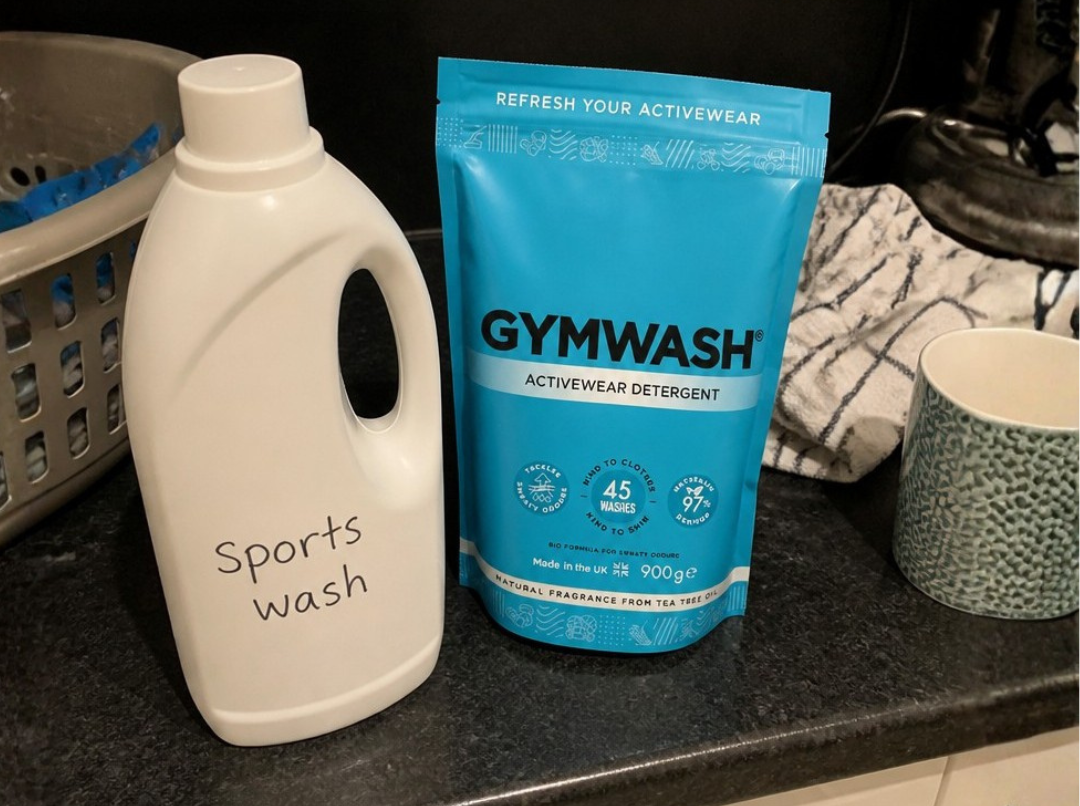
GYMWASH Activewear Laundry Detergent was formulated specifically around persistent activewear odour, rather than being a general detergent later labelled as a sports wash. Its three cleaning routes were selected to perform different jobs within the complete formula.
First, anionic and non-ionic surfactants work with protease (subtilisin), amylase, cellulase and lipase. These routes address oily, protein-based and starch-based deposits, while cellulase supports cleaning and fabric care on cotton and cotton blends.
Second, sodium percarbonate and TAED provide an activated-oxygen route for certain odorous organic residues. Third, zinc ricinoleate is included to bind certain remaining malodour molecules rather than relying solely on fragrance.
The differentiation lies in the deliberate combination. The three systems address different parts of the odour problem rather than repeating the same function. The ingredients and mechanisms are disclosed on the current GYMWASH product page.
So, is GYMWASH the best sports wash? For persistent odour in synthetic activewear, GYMWASH is purpose-built for the job, combining three complementary cleaning routes and backed by over 2,000 five-star customer reviews.
Click here to try GYMWASH Activewear Detergent.